The Desolate Valley
“In the Age after shadow, when the air itself sang of fire, the world was ruled by the Gilded Radiant, He whom mortals named the Dawnfather.”
Derelict is in active alpha, and much of its story is pieced together from item text, environments, boss descriptions and the in-world notes of those who walked the valley before you. What follows weaves those fragments into one telling: part record, part the community's own reading of the dark.
The world of Derelict is a drowned and gilded ruin, a valley of broken cathedrals, frozen courts and bandit-haunted passes, lit by a sun that is worshipped and a moon that is feared. Something ended here. The land is strewn with the wreckage of an age that called itself golden, and stalked by the machines of an age that calls itself the future. And to anyone who reaches the main menu there comes a colder suggestion still: that the whole of it (the gods, the dead, the valley and the traveller who walks it) may be a simulation, run on engines belonging to a company named Avarus. Whatever Derelict is, it is abandoned. That is the meaning of the word, and the wound at the centre of every story told here.
The Gilded Radiant
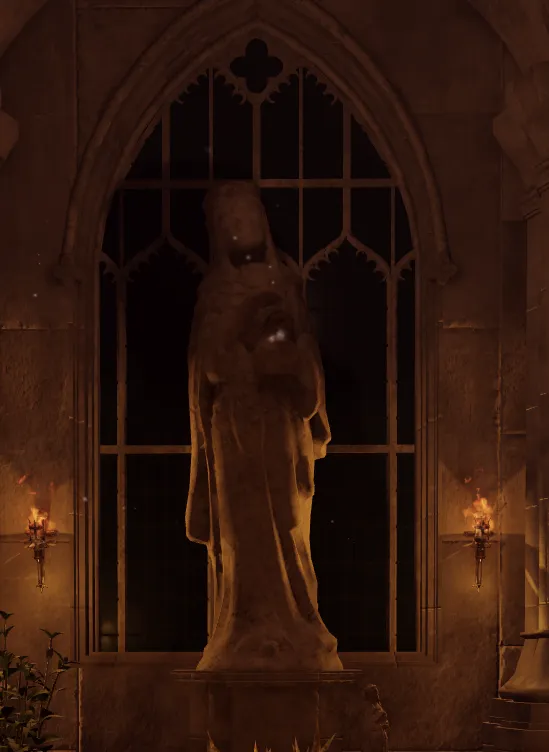
Long before the collapse, the valley belonged to the Sun. Mortals named him the Dawnfather, the Gilded Radiant, and built their faith out of gold, for gold is the vessel of Solar power, and a thing wrought of it can hold a fragment of his light. The Aureatus arms and armour prized to this day are relics of that craft: sun caught and hammered into steel.
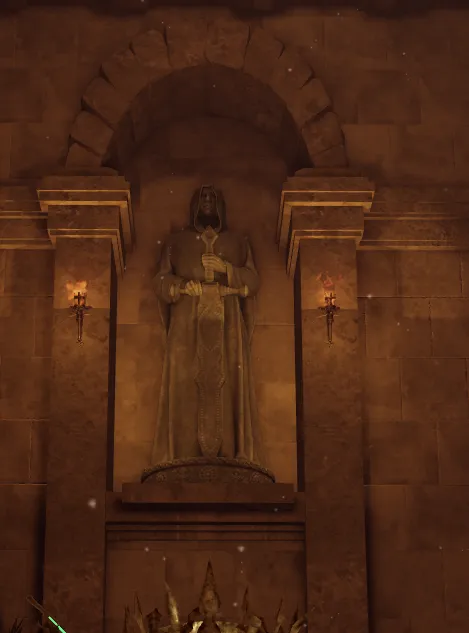
The faith endures in the Veiled Sanctuary and its cathedral, where Solar Priests keep the holy text of the Solar Tome and Solar Knights cut down any who would doubt. The most devout are remade altogether into Brutes, hulking vessels swollen with the god's glowing ichor and kept as living reliquaries. For the Dawnfather is gone, and his church does not mourn him so much as wait. His return, they preach, demands devotion and not doubt; the unworthy kneel and hope to be hollowed into something fit to hold his favour.
The gaze of the Solar God imbues all with radiant power.
The Queen of the Full Moon
Where the Sun is worshipped, the Moon is sealed. In the frozen north (Winterhold, the Aurealis Pass, the crystalline deep) once reigned Melisande, the Oracle, who named herself Queen of the Full Moon. Now she lies bound in her own throne room behind the Aurelfrost Seal, waiting to be loosed, wielding a crescent blade and throwing frost-spectres of herself across the cold.
Hers is a craft of sight rather than fire. The Lunar scrying orbs cloud under a full moon's pride and clear again in the waning crescent's sorrow, kindled not by warmth but by frost's glimmer. Sun and Moon are not allies here; they are the two halves of a broken sky, and the valley is the ground they fell on.
I am Melisande, Queen of the Full Moon… and I will deliver you into the night.
The Scion Neither Heaven Claims
Between the two powers lies a third thing that neither will own. Within the frost, the fragments speak of a scar unseen, a crimson thread woven through fate, a child of some forbidden union whose beating heart stirs the cold stillness. Neither sun nor moon claims the scion, yet both, it is said, fear her existence. Of all the valley's mysteries, hers is the one its rival heavens agree to keep buried.
They Who Wear the Mask
Then came the Avarus Empire. Masked, disciplined and impossibly advanced, they arrived with engines the valley had no words for: plasma, constructs, war-beasts of steel. The scouts who survived their raids could not be certain they were even men.
Are they even human?
The Avarus do not pray. They cannot touch sorcery (not yet, at least), and perhaps that is why they build instead. From the Subjugation Stronghold they hold the passes; from the black-site of Lab Delta they pour out horrors: the mechanized Giant Krab, the plasma-throwing wonder-weapon NR-02. They are blamed for the apocalypse that emptied the world. And if the main menu is to be trusted, they did far more than end it: Avarus Industries may have written it, the valley and all its gods a simulation kept running for reasons no traveller is meant to learn.
The Forging of the Exiled
Not every horror in the valley wears a mask. In Baron's Town sits Lorik Ironheart, a hollow lord who rules an empty town and will not speak his own name. His son fled that blood: once called Damian, he became Asher, the Storm of Vengeance, a prodigal spellblade who took the Weeping Grove for his own and raised the Insurgency against the encroaching Empire.
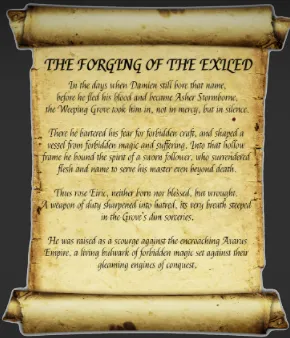
But grief makes poor smiths. To forge a weapon equal to Avarus steel, Asher bound a riven spirit into a vessel of forbidden magic and suffering, and so made Eiric, the Exiled: neither born nor blessed, but wrought. A thing of duty sharpened into hatred, raised as a living bulwark against the gleaming engines of conquest. Yet the enchantments that made him also consumed him, and in the end he had to be chained at the Exile's Ascent, abandoned rather than slain. He lashes there still, the living scar of his maker's vengeance, striking blind at anything that nears.
The Fallen Lords
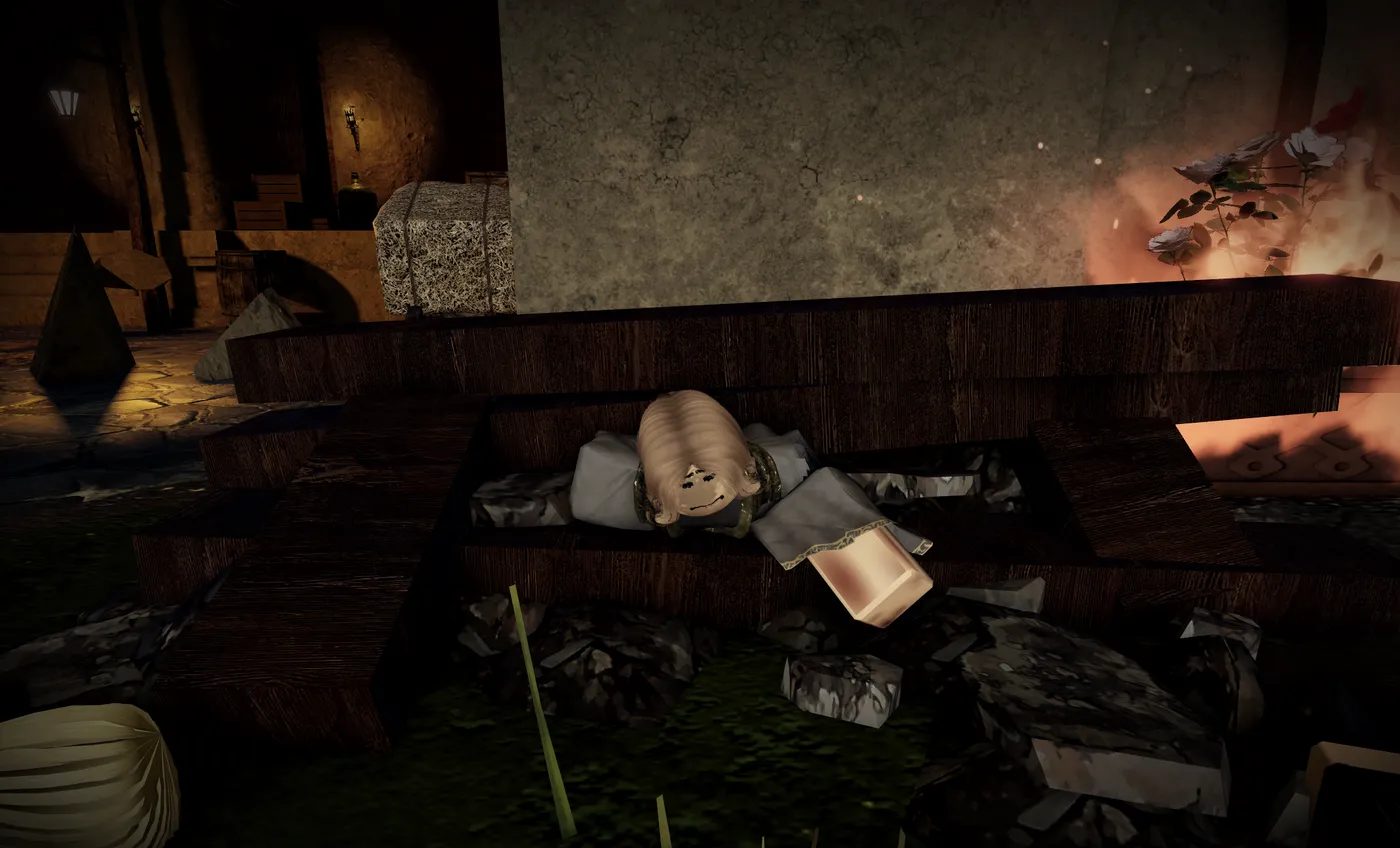
Beneath the Inner Castle Ruins, in the Court of Howls, the Hollow Gale Vorraeth looses arrows in the dark, guarded by the Depraved, and the Royal Depraved, knights who still keep a dead duty to a fallen master. In the mausoleum of Reverie Cemetery, the Profaned Baroness, half-woman and half-serpent, folds her halls into an endless corridor and turns gravity itself against trespassers.
And somewhere between the camps moves Ophelia, who hunts with occult blood-magic for reasons she will not give, and who grows stronger the more Insight the traveller dares to gather. For Insight is the valley's quiet danger: the more you come to understand of this place, the more of it can reach back for you.
The Folk of the Valley
For all its dead gods, Derelict begins small and human. The traveller wakes near Gideon's Camp, where the settler Gideon teaches the old trades (the axe, the pick, the line) and soon names the newcomer protector of Monte Sant'Angelo, his weathered ruin of a cathedral. Gustavo keeps a shop and a stable of sleeping snails he pleads with you not to disturb. Wounded knights such as Percival and Sir Wilhelm press their dying errands on whoever will carry them. The wanderer Caulder surfaces for ten minutes of every hour to trade, and is gone.
They are ordinary people in an emptied world, and through their small requests the traveller is drawn outward: past the bandit caves, across the blockaded Dominion's Pass, into the Feeding Grounds, the frozen north, and at last the Cathedral itself.
What Is Derelict?
So the valley holds its breath between three powers: a sun-god who will not return, a moon-queen who cannot wake, and an empire that may have dreamed them both. Its faithful await a dawn that never breaks; its dead keep duties no one remembers assigning; its newest terror is a machine, and its oldest secret is a child the heavens themselves fear.
Perhaps it is the genuine wreck of a real and golden age. Perhaps it is only a simulation left running after its makers walked away. Either way the name fits, in both its meanings at once: a thing abandoned, and a duty failed.
Step into the GalleryCompiled from in-game text, item and boss descriptions, environments, and the field notes and theories of the Derelict community. As the game grows, so will this telling.